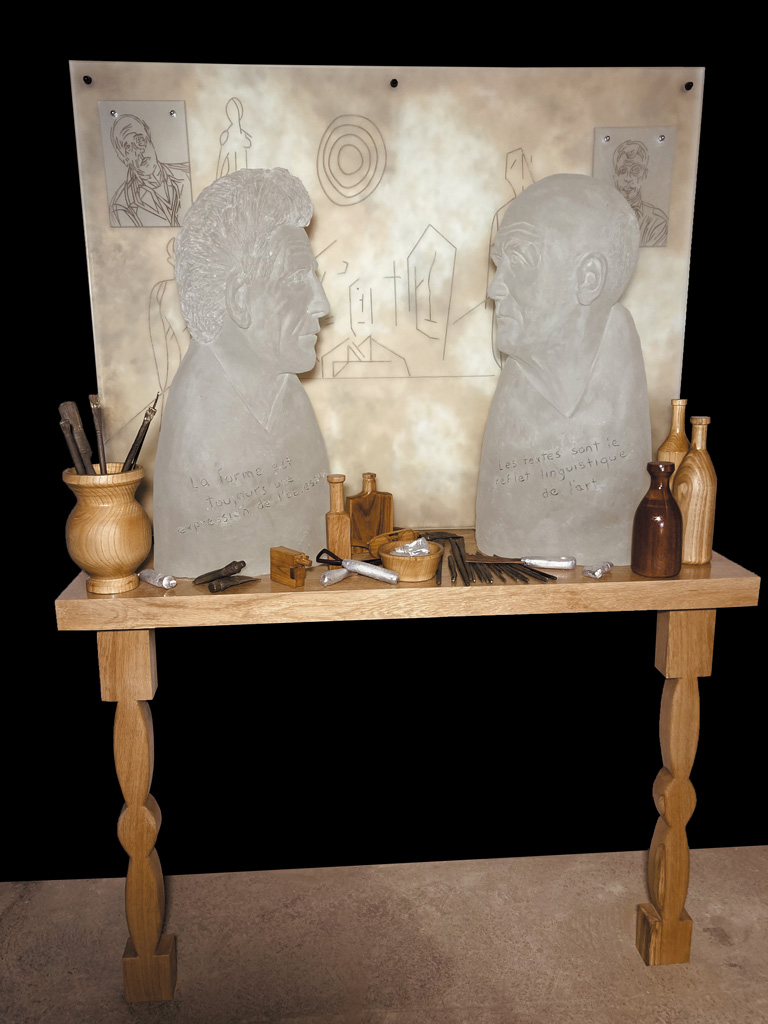
46 Rue Hippolyte Maindron (Alberto Giacometti/Jean Genet)
Materials Sandblasted glass, cast glass, painted aluminum, wood, cast bronze, cast aluminum
For five years after the 1949 publication of Jean Genet’s The Thief’s Journal he experienced writer’s block. In 1954, introduced by Jean Paul Sartre, Genet began regularly visiting the 24 square meter atelier at 46 rue Hippolyte Maindron where Alberto Giacometti lived and worked. During the next several years he sat for nine portraits, three paintings and six drawings. The dialog that was developed during this intense time between 1954 and 1957 was quite special and produced a forty-page essay by Genet, “L’atelier de Alberto Giacometti” that probed the solitude and the desire for perfection that permeated the life and work of the artist. This book was the inspiration for my sculpture. Contrary to most writing about art until that time Genet focused on the philosophical and emotional aspects of creation rather than a technical analysis. This symbiotic relationship allowed Genet to relax and regain the confidence to continue his writing and soon he produced two plays “The Balcony” and “The Blacks”. The relationship between Genet and Giacometti is an example of how artists can influence one another. The two remained close friends until Giacometti’s death in 1966.
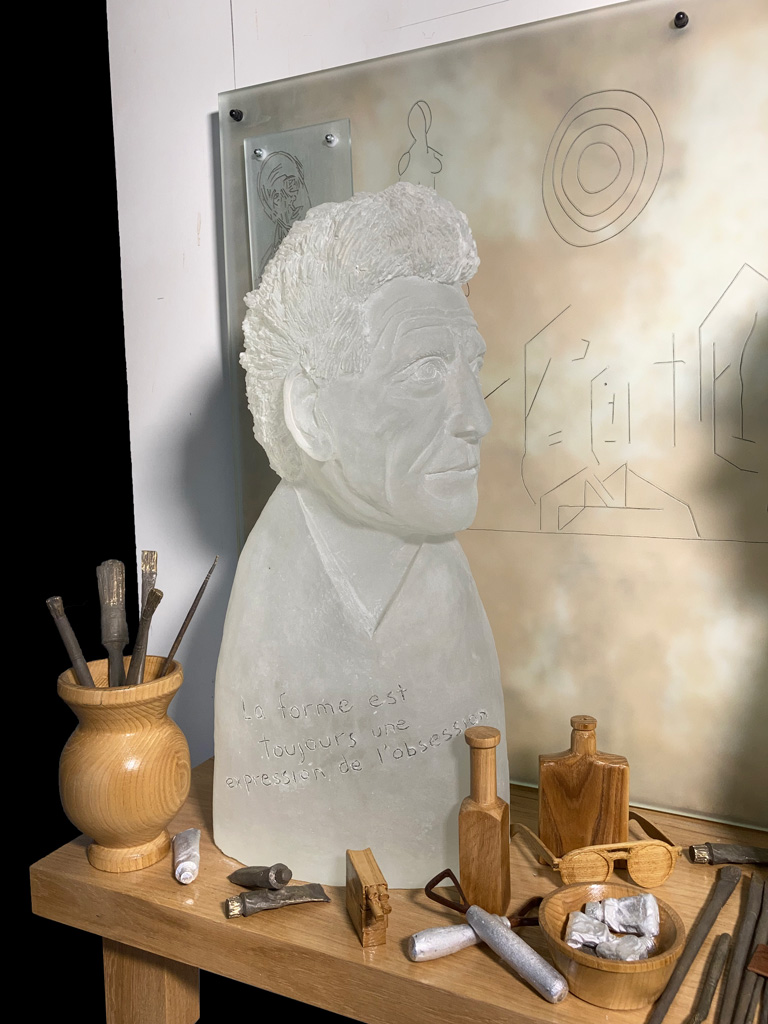
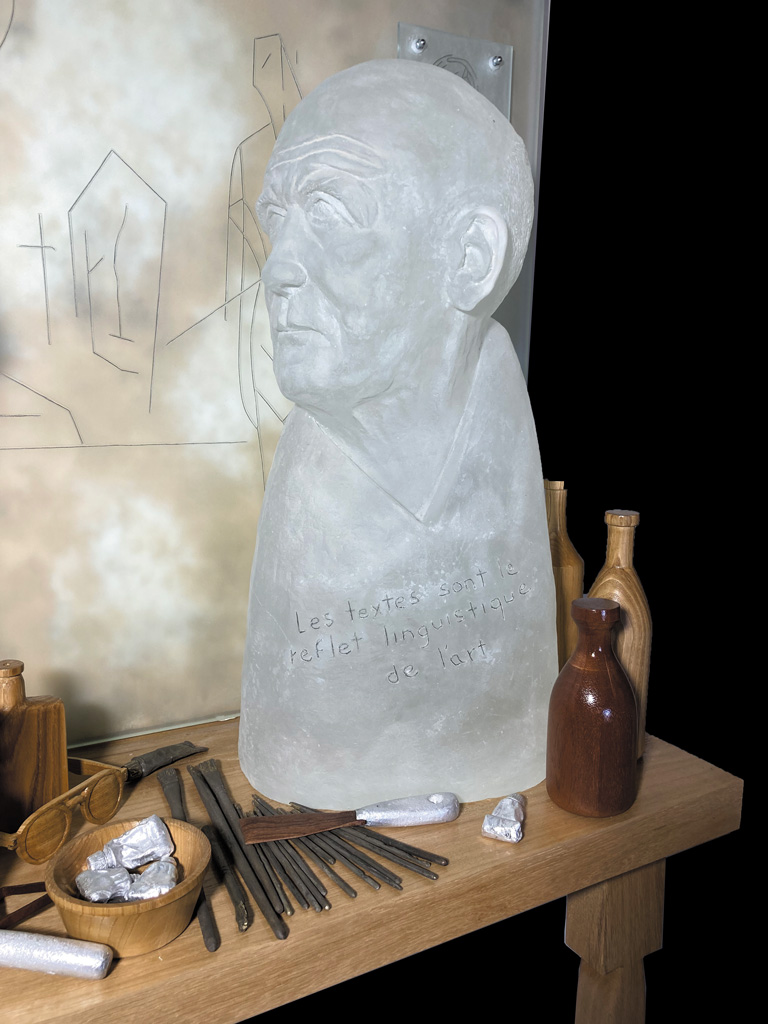
In 1972 when the atelier had to be vacated, Giacometti’s widow Annette removed everything including the plaster painted walls and had it relocated to the Giacometti Institute. From this reconstruction and the many famous photographs, I have chosen a number of details to help tell this remarkable story. The plaster walls were a hodge-podge of colors, light sienna, ochre, white, and black. Into these walls Giacometti incised many designs. Thusly the aluminum support panel is painted, with a sheet of sandblasted flat glass in front that has several of the drawings engraved in the surface. Affixed to this are engraved reproductions of two drawings: a sketch of Jean Genet on the left and a self-portrait on the right. There is a text engraved in each of the large cast glass figures which comes from Genet’s essay: “La forme est toujours une expression de l’obsession” in the figure of Giacometti and “Les textes sont le reflet linguistique de l’art” in the figure of Genet. On the table top I have reproduced in wood, cast bronze, and cast aluminum much of the cluttered mess of brushes, paint tubes, tools, and bottles found in the atelier of Alberto Giacometti.